Truth Social Loses 30% of Traffic as Trump Posts More AI Slop Than Ever and Approval Falls to 33%


Donald Trump's Truth Social platform is experiencing a sharp decline in audience traffic despite the President posting more frequently than ever, flooding the social network with AI-generated videos, bizarre political montages and increasingly extravagant portrayals of himself. According to an October 14 investigation by The Washington Post, citing data from digital analytics firm Similarweb, traffic to Truth Social dropped more than 30% during the year ending in September 2026. The platform averaged approximately 260,000 daily users in September, a steep decline from its June 2025 peak of roughly 420,000, representing a loss of nearly 38% of its daily audience from that high point. The figures reveal a widening contrast between Trump's relentless online activity and the shrinking number of people visiting his platform, which he launched after being suspended from major social networks following the January 6 Capitol attack. The downturn comes at a politically sensitive moment, with Trump's national approval rating falling to 33% just weeks before the November 3 midterm elections. While there is no evidence that his increasingly unusual publications directly caused the traffic decline, the combination has renewed scrutiny of the platform's appeal and the President's unconventional approach to communicating with the public.
Among the most extraordinary examples of Trump's recent Truth Social activity was a late-night posting spree on October 13, when he shared footage of a fatal tiger attack at a British wildlife park before circulating a series of animal-themed videos, several containing fabricated imagery. The original footage, showing a man being fatally attacked by a tiger, appeared alongside Trump's caption, «Don't ever mess with nature! President DJT». He subsequently published a compilation of five apparent lion and tiger attacks, three of which were identified as AI-generated by fact-checking organization Lead Stories. The President then shared another artificial video portraying himself chasing, wrestling and eventually embracing a tiger while the song The Lion Sleeps Tonight played in the background. The unusual sequence continued with a separate video presenting Trump as a lion dominating hyenas, interspersed with images of political opponents including Barack Obama, Nancy Pelosi and California Governor Gavin Newsom. Another recording portrayed Trump as a divinely selected protector of humanity, while describing his adversaries as vipers and wolves. The succession of violent footage, synthetic animal encounters and grandiose political imagery attracted widespread media attention, illustrating the increasingly surreal material appearing on the President's principal social media account.
«THE FAKE POLLS USED BY OUR CROOKED MEDIA ARE OUT OF CONTROL, AND SOMETHING MUST BE DONE ABOUT IT. FCC TO THE RESCUE!»
-U.S. President, Donald Trump, on Truth Social
The recent animal-themed publications are part of a longer pattern of AI-generated content in which Trump has repeatedly presented himself in fantastical, religious or politically provocative situations. In February 2025, he shared a video depicting war-ravaged Gaza transformed into a luxurious coastal resort branded with his name, complete with a towering golden statue of himself, Elon Musk enjoying lavish surroundings and Trump relaxing beside Israeli Prime Minister Benjamin Netanyahu. The fictional redevelopment sparked criticism over its portrayal of a territory devastated by war and mass displacement. In May 2025, shortly after Pope Francis's death, Trump posted an AI-generated portrait showing himself dressed as the pope, seated on an elaborate throne in white papal robes. The image drew objections from Catholic figures, although Trump defended it as a joke. The religious imagery resurfaced in April 2026 when he published another artificial illustration depicting himself in a white robe and red cloak, extending his hand toward a sick person in a scene resembling representations of Jesus performing a miracle. The publication triggered criticism from religious conservatives and was subsequently deleted, with Trump insisting that he had intended the image to portray himself as a doctor rather than a religious figure.
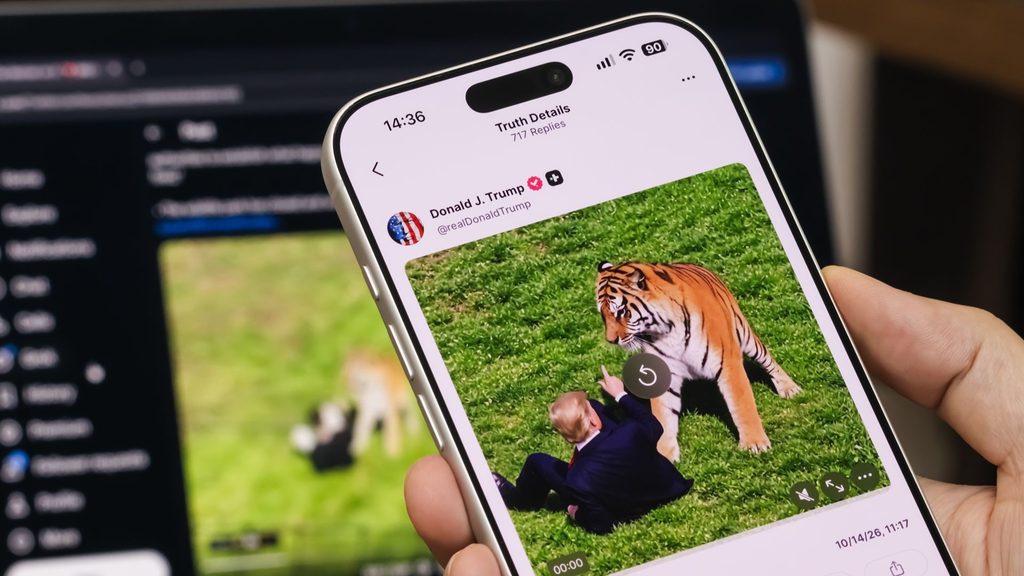
Trump's increasingly elaborate AI productions have also targeted political opponents and demonstrators, transforming real political confrontations into fictional scenes of humiliation and punishment. In October 2025, during nationwide «No Kings» protests, Trump shared an AI-generated video depicting himself wearing a crown while piloting a fighter jet emblazoned with «KING TRUMP». The aircraft was shown flying over demonstrators and dumping what appeared to be excrement onto the crowds, accompanied by Kenny Loggins' song Danger Zone. The musician subsequently objected to the unauthorized use of his recording. Months earlier, in July 2025, Trump had circulated another fabricated video depicting former President Barack Obama being arrested by FBI agents inside the Oval Office before appearing behind prison bars in an orange jumpsuit. No such arrest occurred. More recently, on October 16, 2026, Trump shared photographs promoting renovations at the White House, including a before-and-after image of a restored column that The Verge reported had been altered using AI. Together, the episodes illustrate how artificial imagery has become a recurring feature of Trump's political messaging, sometimes blurring the distinction between satire, self-promotion and misleading representations of actual events.

The President's unconventional online activity has also extended to his repeated attempts to challenge unfavorable opinion polls, which he has frequently characterized as fabricated or politically motivated. In an August 30 Truth Social post, Trump declared, «THE FAKE POLLS USED BY OUR CROOKED MEDIA ARE OUT OF CONTROL, AND SOMETHING MUST BE DONE ABOUT IT. FCC TO THE RESCUE!» Six days earlier, he had accused Democrats of conducting what he called «Demoralization Operations» designed to discourage Republican voters, insisting that the actual polling numbers were favorable to his administration. On October 4, he repeated that argument, writing, «The Polls have ALWAYS underestimated MAGA.» Trump has also promoted older surveys presenting him in a more flattering light. On October 18, he reposted a CNN segment highlighting an earlier poll in which 53% of Republican respondents selected him as their most admired Republican president, ahead of Ronald Reagan and Abraham Lincoln. However, the survey measured preferences among Republican respondents rather than approval across the general population. The recycled footage appeared as more recent national polling showed substantially weaker public support for Trump's performance in office.
«The Polls have ALWAYS underestimated MAGA.»
-U.S. President, Donald Trump, on Truth Social
The contrast between Trump's declarations of popularity and the latest polling has become increasingly significant ahead of the November 3 midterm elections, when Republicans will defend their congressional majorities. A Washington Post–ABC News–Ipsos survey released October 18 found that only 33% of American adults approved of Trump's job performance, while 66% disapproved, including 52% who expressed strong disapproval. The results represented a new low for Trump in that polling series, with his approval of economic management falling to 28% as voters expressed mounting frustration over inflation, gasoline prices and everyday living costs. Among likely voters, Democrats led Republicans 52% to 44% in congressional vote preference, while 75% of Democratic registered voters said they were certain to vote or had already done so, compared with 67% of Republicans. Trump has continued rejecting unfavorable surveys and urging supporters to treat the midterms as though his own name were on the ballot, but the latest figures suggest that his relentless social media presence is not translating into broader public approval. As Truth Social's audience contracts despite an accelerating stream of AI-generated spectacles and political attacks, the President faces two distinct challenges: attracting users to his own platform and persuading an increasingly dissatisfied electorate to support his party in November.
Created by humans, assisted by AI.
 Trump faces historic midterm polling collapse as 82% disapprove on cost of living
 Trump demands arrests of New York Times and other media over reports of empty seats at Ohio rally
