

/https%3A%2F%2Fcdn-tor.buminteractif.com%2F2025%2F12%2F18215559%2FGettyImages-2251248237.jpg)
U.S. President Donald Trump has ordered a “total and complete blockade” of all U.S.-sanctioned oil tankers entering or leaving Venezuela, adding pressure to Venezuelan President Nicolás Maduro's government. The order from Trump comes after weeks of escalating military tension in the Caribbean Sea, and four months of US air strikes on vessels off the coast of Venezuela. The US government claims to be fighting ‘narcoterrorism'.
Details of the blockade
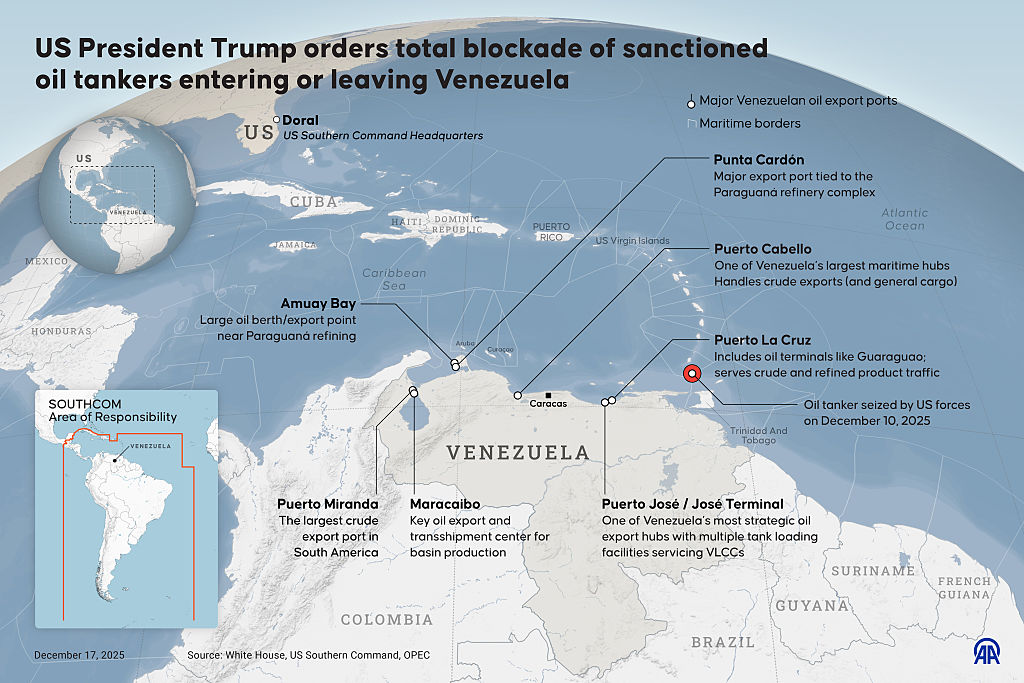
The blockade is meant to stifle Venezuela's main source of income: oil exports. The Venezuelan economy depends heavily on oil exports for its revenue, and the US blockade squeezes oil shipments to international markets, potentially crippling the country's economy and weakening Maduro's grasp on power. Critics are calling the blockade an overt act of war and are questioning its legality.
The blockade consists of 12 U.S. warships, led by the USS Gerald Ford, the largest aircraft carrier in the world. There is also a smattering of other supporting vessels. Amongst them are guided‑missile destroyers USS Winston S. Churchill, USS Bainbridge, USS Mahan, cruisers USS Lake Erie and USS Gettysburg, and amphibious ships USS Iwo Jima, USS San Antonio and USS Fort Lauderdale. There are also 30-50 US aircraft deployed in the area, including F-18s, F-35s and P-series military drones.
Venezuela is completely surrounded by the largest Armada ever assembled in the History of South America. It will only get bigger, and the shock to them will be like nothing they have ever seen before
The U.S.'s seizure of a Venezuelan oil tanker earlier this month is an example of how the blockade will operate, with US military forces boarding and seizing control of the vessel. The vessel was taken under the authority of a federal warrant and detained pending legal proceedings, halting the movement of its cargo of crude oil. US forces will most likely continue to maintain high readiness in the area, rotating vessels and aircraft as needed, while President Trump deals with the global diplomatic impact of his actions.
Trumps comments
In a lengthy post on Truth Social, Trump announced that Venezuela was “completely surrounded by the largest Armada ever.” And that the blockade will “only get bigger” and that the shock to Venezuela will be like “nothing they have ever seen”. It certainly seems like an overt act of war. Trump continues to call Maduro “illegitimate,” something that experts across both sides of the aisle agree on. Maduro lost the Venezuelan election in June of last year, and Venezuela proved it with its own polling technology. Regardless of the loss, Maduro is still in power and has refused to step down. Polling data has found that Maduro only won 30% of the Venezuelan vote, compared to the oppositions 67%. Not only did Maduro lose, but it was a landslide loss. While human rights activists also want Maduro ousted, the way that Donald Trump is doing it brings into question the legality of his actions.
Since September, Trump has been carrying out what many human rights experts call illegal airstrikes in the name of fighting narcoterrorism. Trump has repeatedly accused Venezuela of supporting cartels in smuggling drugs into the US. The US has killed more than 100 people since September, and has not provided concrete proof that these vessels were actually carrying drugs. Venezuela held an emergency meeting on Wednesday regarding the US's blockade.
